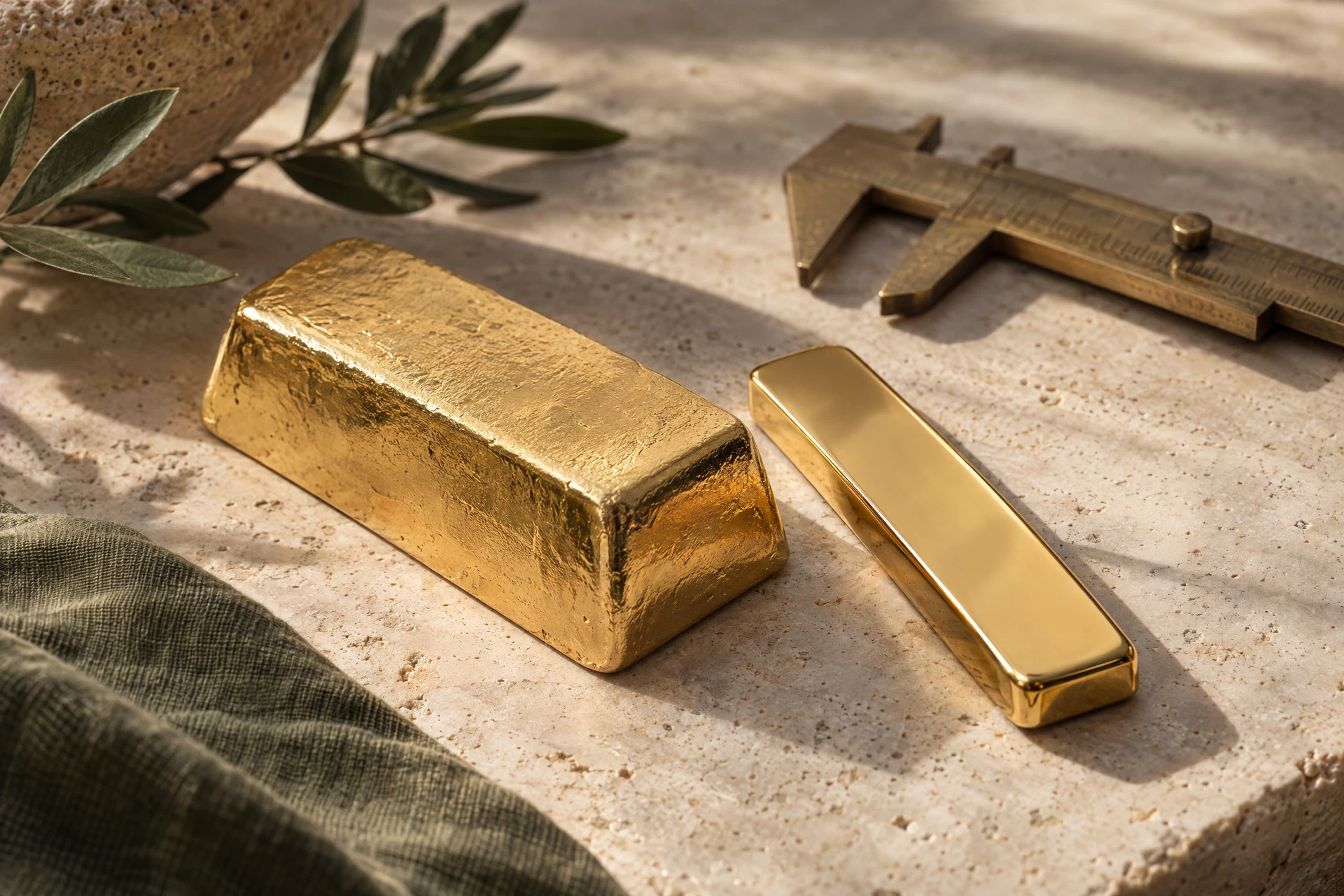
 Illustrative AI-created editorial image. Not a product listing.
- Compare fine-gold content, not only gross weight: 999.9 fineness means 99.99% gold.
- Minted bars are cut and stamped; cast bars are poured into moulds. Neither format alone proves authenticity.
- The premium is the amount above metal value. Small, highly finished bars often cost more per gram.
- Verify the seller, specifications, total price, buy-back terms, delivery, insurance and storage before paying.
What a gold bar represents
A gold bar is bullion: a shaped piece of refined metal whose main value comes from fine-gold content rather than rarity or decoration. Its price combines metal value with a premium for fabrication, assay packaging, distribution and the seller’s margin. The United States Mint describes investment-grade bullion similarly: value follows weight and fineness, not a collectible story [1].
Gold prices move. A dealer usually sells above spot and buys below it; that gap is the spread, so selling may return less than the purchase cost [2].
Weights: grams, troy ounces and fine gold
Retail bars commonly appear in 1 g, 2 g, 5 g, 10 g, 20 g, 50 g and 100 g sizes, plus one-troy-ounce and larger formats. The Perth Mint lists minted gold bars from 1 g to 10 troy ounces and cast bars in several sizes [3]. In India research, the World Gold Council cited 2 g, 5 g, 8 g, 10 g, 50 g and 100 g minted products, with 5 g and 10 g especially popular [4].
Precious metals use the troy ounce: one is 31.1035 grams [5]. Calculate fine-gold grams by multiplying gross weight by fineness as a decimal. A hypothetical 10 g bar marked 999.9 contains about 9.999 g of fine gold; this is only a calculation, not a current valuation. LBMA Good Delivery bars are a separate institutional scale, approximately 400 troy ounces, with minimum fineness 995.0 [6].
Purity and fineness: read the number
Fineness states the gold proportion in parts per thousand: 999.9 means 99.99% and 995 means 99.5%. Karat is another scale; 22 karat means 22 parts gold out of 24, or 91.67% [5]. A product page, stamp or assay card should state weight and fineness clearly. “Pure gold” without a number is not enough to compare offers.
Fineness does not prove authenticity. A counterfeit can carry a 999.9 marking. For large bars, LBMA standards illustrate the importance of a refiner mark, fineness, serial number and production information [6]. For retail bars, use published specifications and verification; packaging is supporting evidence, not a guarantee.
Minted versus cast bars
Minted bars are cut from rolled metal sheet and stamped. They usually have flat faces, crisp edges and a uniform finish, often inside a tamper-evident assay card or blister pack [5]. Cast bars are made by pouring molten gold into a mould and cooling it; they often have a more individual, textured surface and are common in larger sizes [3] [5].
Cast production can reduce fabrication cost, but the price depends on the refiner, size, market and seller. Compare fine-gold cost and resale terms, not appearance. The Perth Mint warns that counterfeiters imitate both formats and their packaging, so a shiny finish or sealed card is not proof of authenticity [7].
Premiums: why smaller bars can cost more
The premium is the difference between a product’s price and its fine-metal value at the relevant spot price. It can cover refining, fabrication, assay packaging, inventory, insurance, shipping, marketing and dealer profit. The Royal Mint notes that larger products are generally cheaper to produce per unit, while small or highly finished products can cost more per unit [8].
Compare like for like: identify fine-metal weight, multiply it by the same-currency spot price, then calculate (retail price − metal value) ÷ metal value. A hypothetical metal value of 100 and price of 106 equals a 6% premium; it is not a market quote. Add tax, shipping, payment and storage costs, and ask for the buy-back price to understand the exit spread [2] [8]. Premiums change with supply, demand, competition, packaging and financing [8].
Authenticity, provenance and red flags
Start with the seller. CFTC and FINRA advise checking a dealer’s physical address, operating history and complaint record rather than trusting an unsolicited call or limited-time pitch [2]. Perth Mint recommends buying directly from a mint or approved distributor and avoiding private or unverified listings [7].
Match weight, dimensions, fineness, refiner mark, serial number and packaging to published specifications. A precision scale is a basic check; do not drill, scratch or acid-test a bar yourself. Fakes may use tungsten or lead beneath a thin precious-metal layer [7]. For a valuable item, use an independent qualified assay service. A demand to buy gold and hand it to a courier or government agent is a scam warning; the FTC issued that warning on July 17, 2025 [9].
A practical purchase checklist
Decide your purpose, preferred denomination and maximum total cost before shopping. Small bars can be easier to sell in parts but often carry higher premiums. A larger cast bar may lower fabrication cost per gram but is less divisible. This is a trade-off, not a promise that one format will outperform another.
Then: (1) compare two or more transparent quotes on the same fine-gold weight; (2) record spot reference and every fee; (3) verify seller and returns; (4) confirm refiner, fineness, weight, dimensions, serial or assay details and packaging; (5) ask for buy-back price and testing deductions; (6) arrange storage and insurance; and (7) keep invoices and delivery records. CFTC says fees and the agreed price should be in writing before payment [2].
Storage, resale and realistic expectations
A home safe, bank box and professional depository differ in access, insurance, privacy and recurring cost. Ask whether storage gives allocated ownership of identified bars or only an unallocated claim [10]. Keep an inventory private.
When selling, compare buy-back quotes and ask whether opened packaging, older bars or another refiner’s products are accepted. No dealer must return your original premium. Gold can lose value, and tax rules vary by country. This guide explains mechanics and safety checks, not a purchase or return forecast.
Questions readers ask
What is the best gold-bar weight for a beginner?
There is no universal best size. Compare premium per gram, storage and whether you may sell only part later. Small bars can be flexible but cost more per unit of fine gold; large bars can be efficient but less divisible. Use current quotes.
Are minted bars better than cast bars?
Not automatically. Minted bars have a precise finish and often tamper-evident packaging; cast bars are mould-poured, textured and sometimes cheaper to fabricate. Compare fine-gold content, refiner, premium, verification and resale terms. Both can be counterfeited.
How can I check a gold bar before buying it?
Verify the seller, then match weight, dimensions, fineness, refiner mark, serial or assay details and packaging with published specifications. Get the full price and buy-back terms in writing. For an expensive bar, use a qualified independent assay service and avoid urgency.
Sources & editorial notes
- [1] United States Mint Bullion Coins — United States Mint
- [2] Customer Advisory: 10 Things to Ask Before Buying Physical Gold, Silver, or Other Metals — Commodity Futures Trading Commission and FINRA
- [3] Information for bullion buyers — The Perth Mint
- [4] Gold refining and recycling: India gold market series — World Gold Council · 2022-06-21
- [5] Bullion Investing Jargon Buster — The Royal Mint
- [6] Technical Specifications — London Bullion Market Association
- [7] How to avoid buying fake coins and bars — The Perth Mint
- [8] What are Bullion Premiums? — The Royal Mint · 2024-01
- [9] Real government agents aren’t asking you to buy and deliver gold bars — Federal Trade Commission · 2025-07-17
- [10] Top eight questions to ask before investing in gold — The Perth Mint · 2025-07-07
Named references are provided for context. This is independent educational writing, not an endorsement or personalised investment advice.
Our editorial policyThis is general education, not personal financial, legal or tax advice. Gold prices and ownership costs can change. Read the disclaimer.