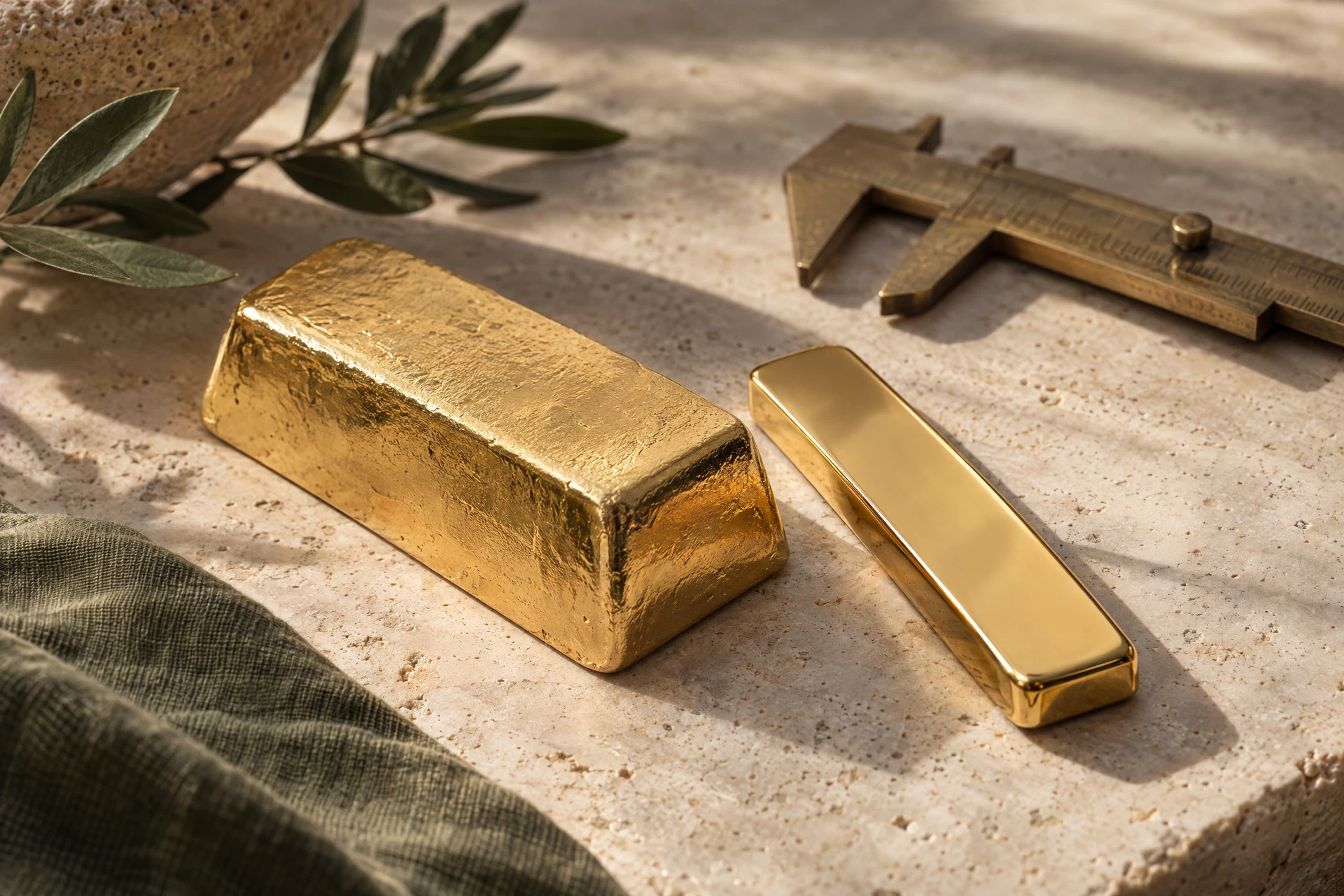
 Illustrative AI-created editorial image. Not a product listing.
- The LBMA international benchmark is a wholesale reference in US dollars per fine troy ounce, not a finished jewellery-shop price. [1]
- A rupee gold rate reflects both the dollar gold quote and USD/INR conversion, plus local market conditions. [2] [4]
- Local premiums, making charges, wastage, stones, hallmarking and GST are separate concepts that should be visible or explainable on the invoice. [3] [5] [7]
- Compare like with like: same purity, net weight, time, tax basis and product type.
1. Spot price is a benchmark, not a jewellery-shop price
The international gold spot price is a reference for standard bullion traded in wholesale markets. The LBMA Gold Price is set twice each business day in US dollars per fine troy ounce of 995 gold, and is also published in other currencies and weight units. It is a starting point, not the final per-gram price of a finished ornament. [1] [1] [2] [3]
A retail quote includes currency conversion, local premium or discount, dealer spread, refining and logistics, design work, stones, hallmarking and tax. Use the spot figure as the metal reference and the invoice as the complete transaction record. [1] [2] [3]
2. How the dollar price becomes a rupee-per-gram rate
A useful conversion is: rupee value per fine gram = international dollars per troy ounce × USD/INR ÷ 31.1034768. The divisor converts a troy ounce into grams. The World Gold Council says its gold-price series is quoted in US dollars and converted into local currency using the foreign-exchange rate at the time, or as close as possible. [2]
If the rupee weakens against the dollar, the rupee equivalent generally rises even when the dollar gold quote is unchanged. The relationship is not one-for-one at a shop because update times and local references differ. RBI says its former daily spot USD/INR reference-rate process moved to FBIL from 10 July 2018; identify the source and time of any rate you use. [4]
3. Why India’s local price can differ from the international quote
A local premium or discount is the gap between a domestic gold price and an international reference after putting them on a comparable basis. It is not automatically a retailer’s profit and is not the same as a making charge. World Gold Council calls its India series a directional, indicative gauge rather than a trading metric and uses a five-day rolling average to reduce noise. [3]
The gap can reflect import and financing costs, taxes, transport, refining, local stock, festival demand and liquidity. Compare shops using the same date, purity, unit, tax treatment and product type. A tax-inclusive 22-carat ornament rate should not be compared directly with a raw international ounce quote. [3]
4. Purity and weight change the metal value
A fine-gold benchmark cannot be copied directly onto 22-carat or 18-carat jewellery. In a simplified calculation, fine-gold content equals net metal weight × fineness. A 916-marked article therefore contains about 91.6% gold by mass; the balance is alloy. The invoice should state purity and fineness clearly. [7]
Use net precious-metal weight, not gross weight that includes stones or non-gold parts. Ask whether the quoted rate is for fine gold, 22-carat jewellery or another purity. BIS says consumers can use the BIS CARE app’s Verify HUID feature for hallmarked gold items. [6]
5. Retail premium is different from making and wastage charges
A local premium connects a physical-market quote with the international reference. Making charges pay for converting metal into a specific design and may be a percentage, per-gram rate or flat amount. Wastage is a commercial term, not a universal component of the international gold price. A low making-charge offer can still use a higher metal rate, so compare the full pre-tax price. [3]
Keep stone costs separate from gold weight and value, and check what a discount reduces. BIS says hallmarking charges are per article, not by weight, and do not include making or wastage charges. [7]
6. Read a jewellery bill from top to bottom
Check the article description, quantity, gross weight, stone or non-gold weight, net precious-metal weight, purity, fineness and rate. BIS says a bill for a hallmarked precious-metal article should state the description, net weight, purity in carat and fineness, and hallmarking charges; an authentic invoice supports dispute or complaint redressal. [7]
Then identify metal value, making or job-work amount, stones, wastage or other charges, discount, taxable value and GST. CBIC’s jewellery FAQ says GST is 3% of total transaction value whether making is shown separately or not. It separately describes 5% on a registered job worker’s job-work charges in the relevant manufacturing arrangement. [5]
7. A hypothetical bill calculation
This is a deliberately hypothetical example, not a market quote. Suppose an invoice lists 8.00 grams of 22-carat gold at ₹6,000 per gram, making charges of ₹9,600 and no stones. Metal value is 8.00 × ₹6,000 = ₹48,000. Add making charges for a pre-tax value of ₹57,600. At the 3% GST rate in CBIC’s jewellery FAQ, tax is ₹1,728 and the illustrative total is ₹59,328. [5] [5] [7]
In a real bill, confirm the purity basis, net weight, stone treatment, hallmarking line and whether discounts were applied. The example does not establish today’s rate or recommend a purchase. [5] [7]
8. A practical comparison checklist
Before comparing a shop quote with a spot chart, record date and time, currency, weight unit, purity basis and whether the figure is before or after local costs and tax. Convert the international quote to rupees per fine gram, adjust conceptually for purity, then examine premium, making, stones and GST. [1] [2]
Match each article to its HUID or hallmark information where applicable and retain the invoice. BIS says each article in a pair and required detachable parts should carry hallmark information, and describes testing through a recognized Assaying and Hallmarking Centre. These checks do not predict prices or guarantee resale. [6] [7]
Questions readers ask
Why can an Indian jewellery rate rise when the international gold price is flat?
The international quote is in dollars, so a weaker rupee can raise its rupee equivalent. A local premium, inventory cost, tax, dealer spread or a different update time can also change the shop rate. Compare the same purity, unit, timestamp and tax basis before drawing a conclusion. [2] [3] [4]
Is a making charge the same as a gold-price premium?
No. A local premium or discount describes the relationship between a domestic physical-market price and an international reference. A making charge is the seller’s charge for producing the specific design. A bill can contain both, even though a shop may present them through a single product quote. [3]
What should a hallmarked jewellery invoice show?
BIS’s consumer FAQ says the bill should include the article description, net precious-metal weight, purity in carat and fineness, and hallmarking charges. Keep an authentic invoice, and use the BIS CARE app’s Verify HUID feature where applicable. [6] [7]
Sources & editorial notes
- [1] Precious Metal Benchmarks, A Guide to the Loco London Precious Metals Market — London Bullion Market Association (LBMA) · 2017
- [2] Gold Price Methodology — World Gold Council · Undated (accessed 2026-10-13)
- [3] Local gold price premium/discount — World Gold Council · 2026-10-12
- [4] Computation and Dissemination of Reference Rate - Taking Over by Financial Benchmarks India Private Limited (FBIL) — Reserve Bank of India · 2018-07-04
- [5] Sectoral FAQs: GST on jewellery and making charges — Central Board of Indirect Taxes and Customs · 2017 (FAQ)
- [6] Consumer Protection: Hallmarking — Bureau of Indian Standards · 2025-11-26 (last updated)
- [7] Common Consumer FAQ: Hallmarking — Bureau of Indian Standards · 2020-12-10
Named references are provided for context. This is independent educational writing, not an endorsement or personalised investment advice.
Our editorial policyThis is general education, not personal financial, legal or tax advice. Gold prices and ownership costs can change. Read the disclaimer.