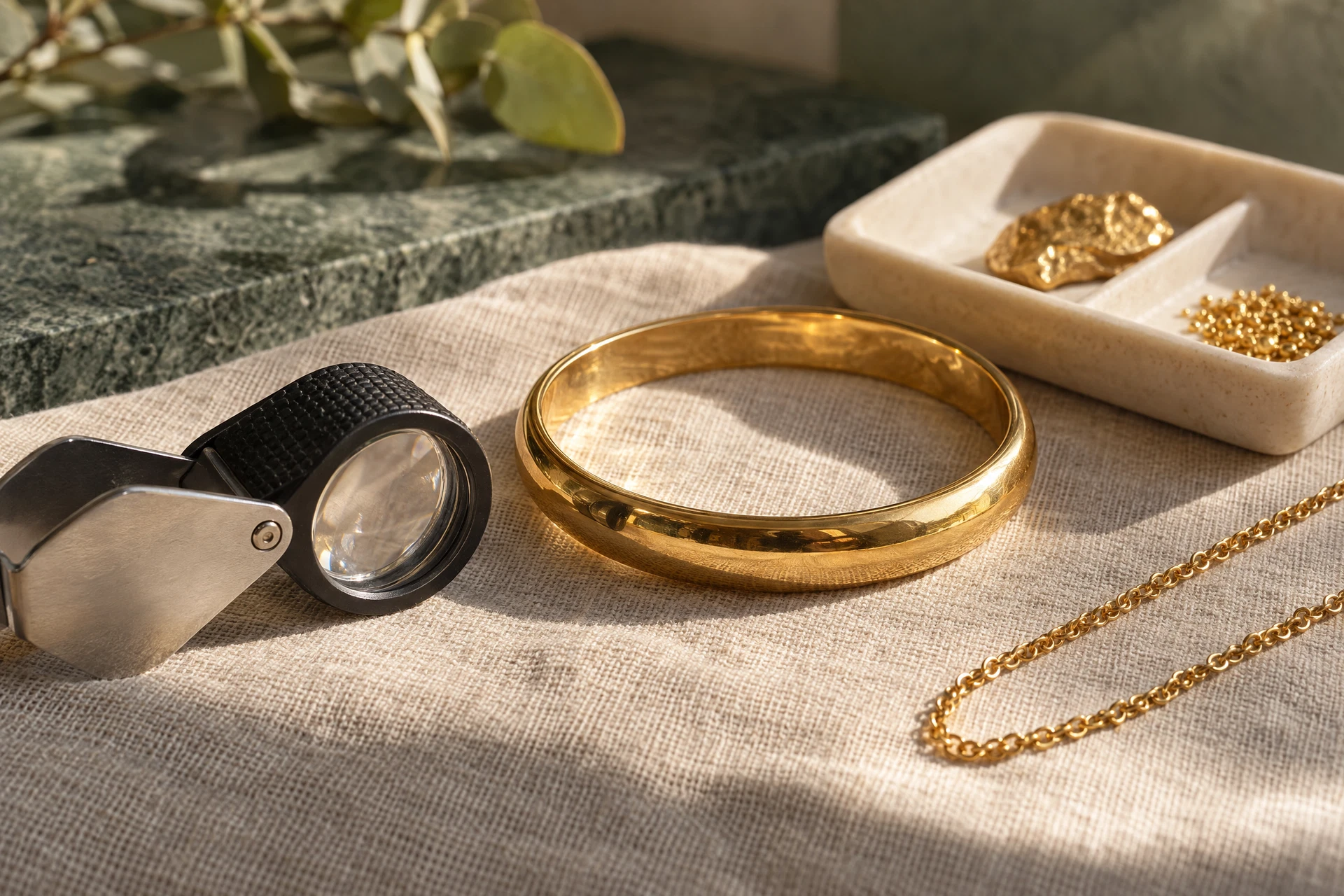
 Illustrative AI-created editorial image. Not a product listing.
- BIS hallmarking records precious-metal content and helps protect consumers from purity misrepresentation. [1]
- BIS lists 22K(916) and 24KS(995); read carat and fineness together. [2]
- A hallmark has the BIS logo, purity mark and unique six-digit alphanumeric HUID. [2]
- Verify HUID in the BIS Care App and match the article with its detailed invoice. [2] [4]
What Indian hallmarking actually tells you
Hallmarking is BIS’s system for accurately determining and officially recording the proportion of precious metal in an article. In practical terms, it is an independent purity record rather than a description supplied only by a seller. BIS says the scheme is designed to protect the public from adulteration and to require legal fineness standards for gold and silver articles. [1]
22K versus 24K: read the number beside the K
Carat, written as K in gold purity marks, expresses gold content out of 24 parts. Fineness expresses the same idea in parts per thousand. BIS’s current FAQ lists these permitted gold grades for jewellery and artefacts: 14K(585), 18K(750), 20K(833), 22K(916), 23K(958) and 24KS(995). [2]
That makes 22K(916) a clear, checkable claim: about 916 parts out of 1,000 are gold, or 91.6% by fineness. The BIS-listed 24KS(995) grade represents 995 parts out of 1,000, or 99.5%. The word “24K” is often used casually, so the fineness number stamped on the article is the more precise reference when the BIS mark is being read. [2]
These grades also explain why two articles with different K marks should not be treated as interchangeable purity claims. For a hypothetical 10-gram article, 22K(916) would correspond to about 9.16 grams of gold content before any transaction-specific calculations, while 24KS(995) would correspond to about 9.95 grams. This is only a purity illustration, not a price, valuation or resale calculation.
Fineness makes the claim easier to verify
Fineness is written as a three-digit number because it states the gold proportion per 1,000 parts. A mark of 916 should therefore be read as 916/1000, not as a serial number or a weight. In the same way, 750 indicates 750/1000 and 585 indicates 585/1000. BIS pairs each of those numbers with a caratage in its list of recognised grades. [2]
The three parts of a current BIS gold hallmark
BIS says that, since the introduction of HUID on 1 July 2021, a hallmark on gold jewellery consists of three marks: the BIS logo; the article’s purity in caratage and fineness; and a six-digit alphanumeric HUID. [2] These marks work together. The logo points to the BIS hallmarking system, the purity pair states the grade, and the HUID connects the individual item to a traceable record.
Look at the article itself under the shop’s magnifying glass rather than treating a display card as the hallmark. BIS’s consumer FAQ says a registered jeweller should display the BIS registration certificate, provide a magnifying glass of at least 10× magnification for showing the mark, and display the relation between fineness and caratage. [2] [4]
Small or awkwardly placed marks are not, by themselves, proof that an item is wrong. The practical test is consistency: the physical mark, HUID result and invoice should describe the same article and purity.
How to verify a HUID in the BIS Care App
HUID means Hallmark Unique Identification. BIS describes it as a unique, traceable six-digit alphanumeric number for each hallmarked item. The BIS Care App includes a “Verify HUID” feature for checking the authenticity information associated with a hallmarked jewellery item. [2] [5]
A simple verification sequence is: note the HUID exactly as stamped; open the official BIS Care App; register a mobile number if the app asks for it; choose “Verify HUID”; enter the six-character code; and compare the returned details with the article in front of you. BIS states that this check can also provide information related to the jeweller’s registration number. [3] [5]
Treat the app result as one part of verification, not as permission to ignore the metal mark or paperwork. A code copied incorrectly can fail, and a result that identifies a different purity, article or jeweller should be treated as a mismatch requiring clarification. Do not substitute an unverified website or a seller’s screenshot for the official BIS Care App.
Check every item, pair and detachable part
BIS consumer guidance says each article in a pair should carry a hallmark. It also says every detachable part should have a hallmark, with different HUIDs, because a part can be replaced or removed. [2] [4] This matters for earrings, linked pieces, pendants with removable components and ornaments with separately attached elements.
Use the invoice as the article’s written record
BIS says an authentic bill or invoice is necessary for the hallmarked article and should contain article details for dispute, misuse or complaint redressal. Its consumer guidance specifies the description of each article, net weight of precious metal, purity in carat and fineness, and hallmarking charges. [2] [4]
What to do when the information does not match
If the mark is difficult to read, the HUID result does not correspond, or the invoice omits required details, ask for the discrepancy to be explained before relying on the record. You can also consult a BIS-recognised Assaying and Hallmarking Centre. BIS says a common consumer may have jewellery or a sample tested there on a chargeable basis, and the centre must issue an assay report identifying the marks on the article. [1] [2]
BIS’s consumer FAQ also provides an online and app-based complaint route. For a hallmarked precious-metal article that does not conform to the relevant standard, the FAQ cites the compensation provision in Rule 49 of the BIS Rules, 2018: two times the amount of the difference calculated from the purity shortfall and article weight, plus testing charges. The applicable facts and process must be established through the official complaint and testing channels; this statement is not a promise of an individual outcome. [3]
Questions readers ask
Is 24K jewellery always marked 999 in India?
Do not infer the fineness from “24K” alone. BIS’s FAQ lists 24KS(995) among the permitted gold grades for jewellery and artefacts, alongside 22K(916), 23K(958), 20K(833), 18K(750) and 14K(585). Read the actual carat-and-fineness pair on the hallmark and invoice. [2]
Can I verify a HUID without visiting a hallmarking centre?
Yes. BIS says consumers can use the “Verify HUID” feature in the BIS Care App to check the six-digit alphanumeric HUID and obtain associated information, including the jeweller’s registration details. Physical marks and the invoice should still be checked alongside the app result. [2] [3] [5]
What should be checked on an invoice for hallmarked gold?
BIS consumer guidance says the bill or invoice should include a description of each article, the net weight of precious metal, purity in carat and fineness, and hallmarking charges. These details should agree with the article and its HUID record. [4]
Sources & editorial notes
- [1] Hallmarking overview — Bureau of Indian Standards · 2026-04-23
- [2] General Hallmarking FAQs — Bureau of Indian Standards · 2025-11-26
- [3] Consumers: Mandatory Hallmarking FAQs — Bureau of Indian Standards · 2025-11-26
- [4] Common Consumer Hallmarking FAQs — Bureau of Indian Standards · 2020-12-10
- [5] BIS Care App — Bureau of Indian Standards · 2025-09-24
Named references are provided for context. This is independent educational writing, not an endorsement or personalised investment advice.
Our editorial policyThis is general education, not personal financial, legal or tax advice. Gold prices and ownership costs can change. Read the disclaimer.