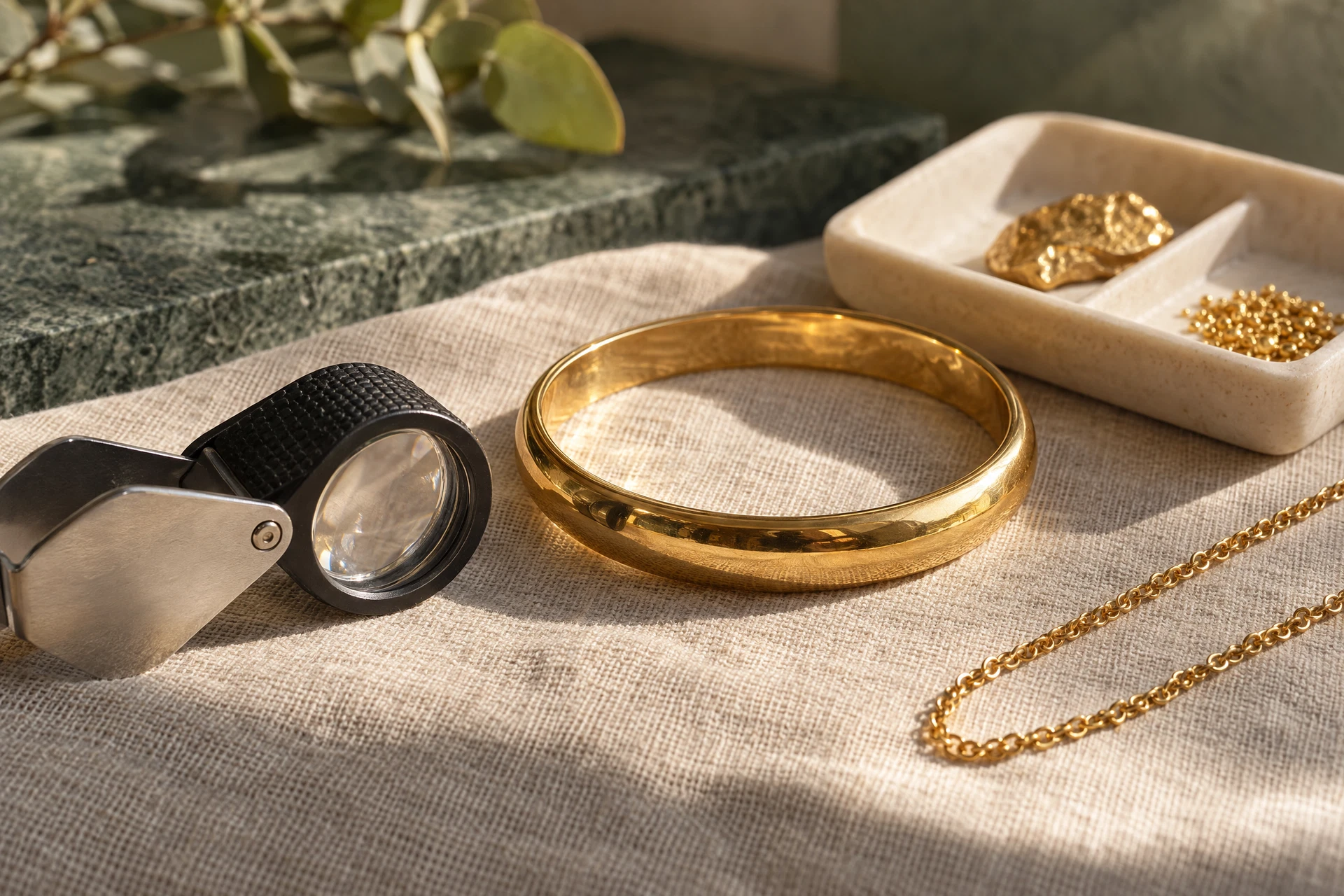
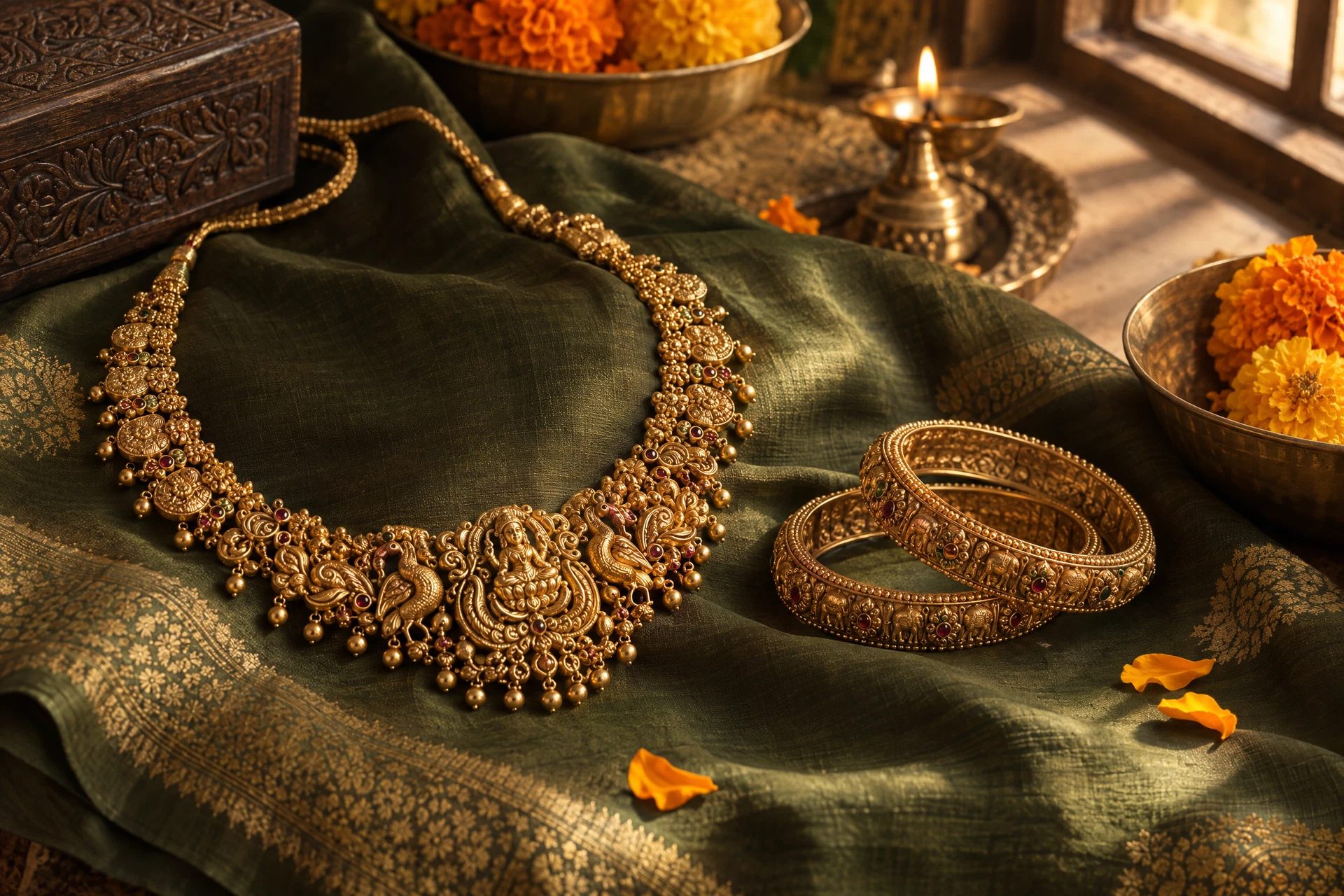
 Illustrative AI-created editorial image. Not a product listing.
- Gold jewellery in India carries several meanings at once: ritual, identity, family continuity, adornment and financial security.
- Wedding gold is often discussed as streedhan, but its emotional meaning belongs to the person and the family who live with its story.
- Resale value is based on measurable inputs such as purity, net gold weight, the rate applied and the buyer's deductions; it is not a measure of love or memory.
- A hallmark, HUID verification, invoice and a clear record can protect the factual identity of an object without reducing its personal meaning.
- The most honest way to hold gold is to let sentimental value and material value coexist, while refusing to mistake either for a guaranteed return.
Gold is part of the occasion, not merely an accessory
In many Indian homes, gold enters a room with meaning already attached. It arrives in a wedding box, rests beside a festival lamp or comes out when a daughter visits. A chain may be worn daily, yet also carry the presence of the aunt who gave it, the first salary that paid for it or the ceremony at which it changed hands. The World Gold Council describes gold in India as closely tied to religion, tradition and festivals, with weddings and festivals among the major purchase occasions [1].
That overlap makes gold intimate. It is wearable, durable and recognisable across generations. This does not mean every Indian family relates to it in the same way; communities and household economies differ. It means a piece of gold often has a social biography before anyone asks what it might fetch at a resale counter.
At weddings, jewellery can mark belonging and responsibility
Wedding jewellery is more than decoration. The World Gold Council estimates bridal jewellery at 50–55% of India’s gold jewellery market by weight and links wedding gold with streedhan, property associated with a woman’s marriage and intended to remain hers [1]. The term has complex legal and social histories, but it helps explain why a necklace or bangle may be understood as security as well as ornament.
Consider a hypothetical family giving a bride bangles in her grandmother’s style. To one relative they represent continuity; to the bride they may also represent agency: something she owns, wears, redesigns or passes on. The same object can be ceremonial in the morning and practical in the evening. Treating it only as a commodity misses why families care so deeply about its custody.
A gold gift is often a sentence in the language of relationships
Gold gifts mark more than weddings. They can accompany a birth, birthday, festival, new home or a moment when a family wants to say that someone’s future matters. The World Gold Council calls gold gifting deeply ingrained in marriage rituals and notes its place in religious and regional celebrations [2]. A small Diwali coin and wedding earrings may be made of the same metal but carry very different messages.
That message depends on who gives, who receives and what the family remembers. A modest pendant bought after months of saving may matter more emotionally than a heavier piece chosen without the recipient’s taste in mind. A gift can be materially small and emotionally enormous. Its meaning is real, but it is not an extra premium a jeweller must pay.
Daily wear keeps tradition in motion
Gold is not confined to bridal chests. Chains, earrings, rings and bangles can accompany work, prayer, travel and family visits. The World Gold Council separates bridal, daily-wear and fashion jewellery while noting that bangles and chains cross those categories [1]. That fluidity matters: an heirloom does not have to remain untouched. Sometimes it survives because someone keeps wearing it.
Regional motifs can recall a place, language or craft tradition. A piece inherited in one city may be remodelled in another without losing its origin; even a repair can become part of its story. Choosing how an old piece should live today need not reject tradition. It can be tradition functioning as a living practice rather than a museum display.
Sentimental value and resale value answer different questions
Sentimental value asks what an object means and what memory it keeps available. Resale value asks what measurable material a buyer can recover under particular terms. The World Gold Council describes gold in India as serving the twin motives of adornment and investment [5]. That distinction is useful: a ring can be a parent’s memory and a quantity of metal without those truths competing.
A resale offer cannot price a blessing, a familiar clasp or the moment a mother fastened a chain before a ceremony. Sentiment cannot change purity, net gold content or a buyer’s policy. Keeping the categories separate is not cold-hearted; it prevents disappointment. A family can say both “this is precious to us” and “its recoverable material value should be assessed honestly.”
Resale value is a calculation with several moving parts
For old jewellery, the current gold rate is only a starting point. LiveMint identifies purity, net gold weight, the rate applied, making charges, testing or other deductions, hallmark verification and buyback terms as relevant factors [6]. Stones, beads and other non-gold material may be excluded, while the making charges paid at purchase are generally not recovered on sale [6]. A high headline gold price therefore does not automatically mean an equally high offer for a finished ornament.
BIS defines hallmarking as the official determination and recording of precious-metal content, intended to protect the public from adulteration and enforce fineness standards [3]. Its consumer guidance says a HUID can be checked through the BIS Care app and an article can be tested at a recognised Assaying and Hallmarking Centre [4]. Verification supports a purity claim; it does not promise a resale price, which still depends on weight, deductions and terms.
A hypothetical example shows why the two values diverge
Imagine, purely as an illustration, a 22-karat necklace with a decorative stone section. A jeweller may separate net gold weight from stones, apply a buying rate for the assessed purity and state any testing or policy deductions. The calculation concerns metal and transaction terms. It has no line for the years the necklace appeared in wedding photographs or the comfort it gives its owner. This example uses no current price and predicts no actual offer.
The reverse error is also common: assuming a meaningful heirloom must be a strong financial asset. A beautiful design may include making work that a later buyer will not pay for, and a hallmark can establish fineness without fixing the market’s preferred rate. Understanding the limits helps a family decide whether to wear, repair, redesign, store or retain a piece for its story, without presenting that decision as an investment promise.
Preserve the record as carefully as the memory
A simple record can protect an heirloom without turning it into a spreadsheet. Keep the invoice if available, note approximate weight and description, photograph distinctive marks, and record who gave the piece and when. If it carries a HUID, verification adds useful factual evidence. If purity is questioned, BIS provides consumer-testing routes through recognised centres [4]. These steps support clarity, not a recommendation to buy, sell or borrow against gold.
A family archive can hold two entries for one necklace. One says what it is made of and how its identity can be checked. The other says whose hands placed it around a neck and which day made it important. The first supports fair description; the second protects meaning. Material value changes with rates and terms, while emotional value may deepen through use. Neither needs to impersonate the other.
Questions readers ask
Why is gold jewellery so closely associated with Indian weddings?
Wedding jewellery combines adornment, ritual, family identity and, in many households, a form of property associated with the bride. The World Gold Council identifies weddings and festivals as major purchase occasions and describes bridal jewellery as the largest estimated segment by weight [1]. Practices differ across communities, so this is a broad cultural pattern rather than a rule for every family.
Why can sentimental value be higher than resale value?
Resale value measures recoverable material under a particular buyer's rate and deductions. Sentimental value includes memory, relationship, identity and continuity. A resale counter can assess purity and net gold weight, but it cannot price who gave the object or what an occasion meant.
Does a BIS hallmark guarantee a particular resale price?
No. BIS explains that hallmarking records precious-metal content and helps protect consumers against irregular quality [3]. HUID verification can support the item's recorded purity [4], but a resale offer still depends on net gold weight, the applicable rate, non-gold components, deductions and the buyer's policy [6].
Sources & editorial notes
- [1] Jewellery demand and trade: India gold market series — World Gold Council · 2023-01-19
- [2] India — World Gold Council · n.d.
- [3] Hallmarking overview — Bureau of Indian Standards · 2026-04-23
- [4] Consumer Protection — Bureau of Indian Standards · 2025-11-26
- [5] Gold investment market and financialisation: India gold market series — World Gold Council · 2023-07-12
- [6] Selling old gold jewellery? 7 factors that determine its resale value — LiveMint · 2026-10-12
Named references are provided for context. This is independent educational writing, not an endorsement or personalised investment advice.
Our editorial policyThis is general education, not personal financial, legal or tax advice. Gold prices and ownership costs can change. Read the disclaimer.